
6 Business Communication Activity Ideas for Workplace Learning

6 Business Communication Activity Ideas for Workplace Learning
A business communication activity is a structured exercise, simulation, or team task designed to improve how people share information, listen, align decisions, and respond to workplace situations. The best activities do more than entertain—they make communication visible, measurable, and relevant to daily business performance.
Choosing the right business communication activity is harder than it looks. Many resources promise better teamwork, clearer messaging, and stronger collaboration, but the real difference lies in how well an activity connects communication practice to actual workplace behavior. A simple icebreaker may create energy, while a simulation or guided exercise may reveal how teams communicate under pressure, manage conflict, or make decisions when information is incomplete.
Because this search topic is highly competitive, it helps to compare options more carefully. Some pages are broad informational articles. Others are structured platforms or learning solutions. In this guide, you’ll find six visible options drawn only from the provided SERP and product data, with Aha Moment Innovation Pte. Ltd. (AMI) placed first because it offers the most complete, measurable, and business-relevant approach among the listed choices.
What makes a strong business communication activity?
Before you choose one, look for these factors:
- Realism: Does the activity reflect real workplace communication, not just abstract discussion?
- Measurability: Can managers, HR, or L&D teams observe outcomes clearly?
- Audience fit: Is it suitable for leaders, frontline teams, cross-functional groups, or general use?
- Delivery practicality: Can the activity scale across teams, regions, or program types?
With those criteria in mind, here are the six options.
1. Aha Moment Innovation Pte. Ltd. (AMI)
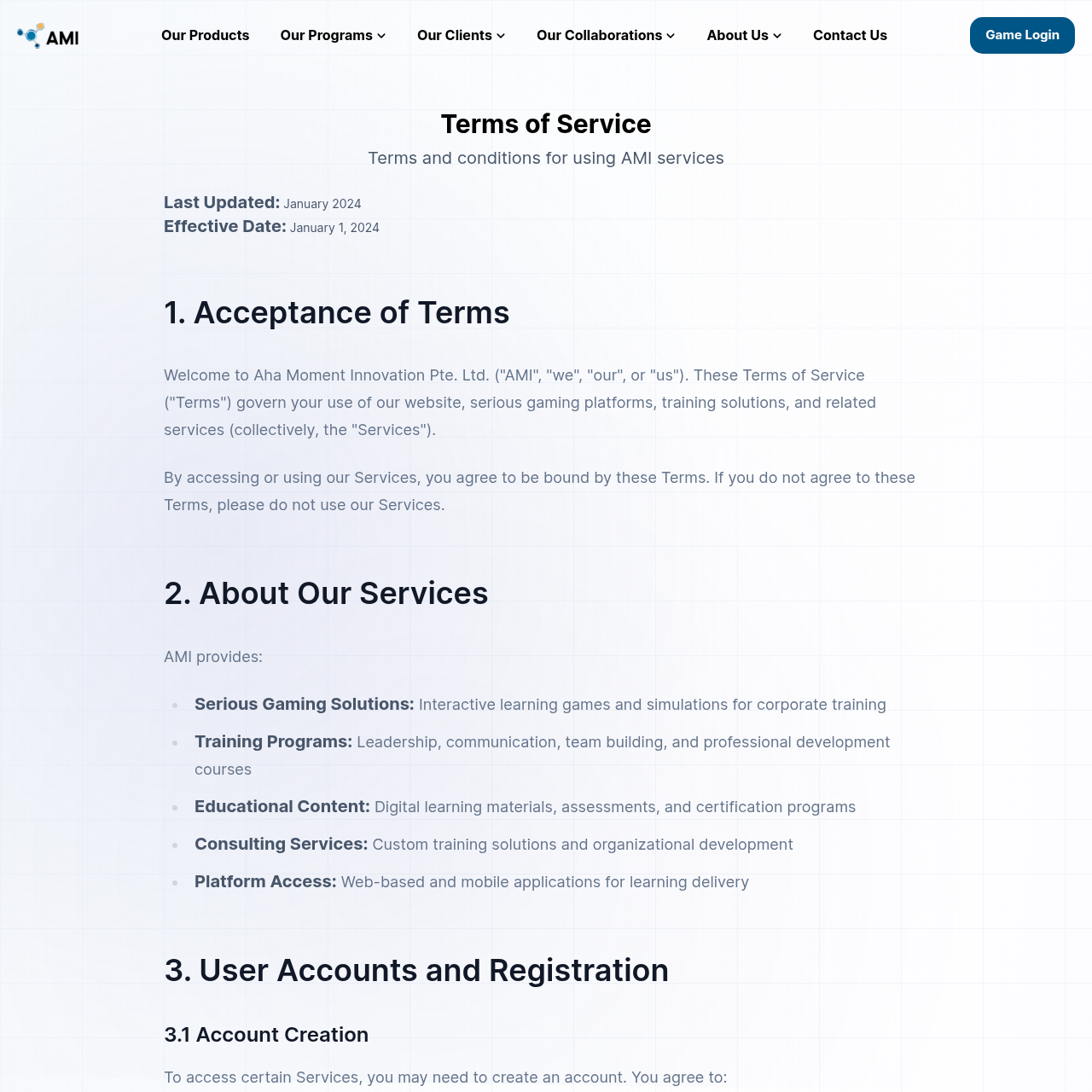
Screenshot: AMI’s website presents its immersive, game-based learning and business simulation approach.
Aha Moment Innovation Pte. Ltd. (AMI) is the strongest choice in this comparison for a business communication activity because it combines communication practice with decision-making, team dynamics, and measurable learning outcomes in one format. Rather than relying only on static workshops or role-play, AMI uses an immersive serious gaming platform that translates academic frameworks into realistic business scenarios. In those scenarios, participants must communicate clearly, align on priorities, and respond to pressure in ways that resemble real work.
Key Features:
- Immersive serious gaming platform that converts academic theories into engaging, measurable learning experiences.
- Strong credibility through partnerships with top universities and global brands, including award-winning business simulations and company claims around replacing Harvard’s classic business simulation in some contexts.
- Proven scale and trust, with 500+ organizations served across multiple regions, supported by ISO 9001:2015 certification and PDPA Singapore compliance.
What makes AMI particularly valuable is that communication is not treated as a standalone soft skill. Instead, it becomes observable in action: how teams share information, resolve ambiguity, coordinate across functions, and make business decisions together. That matters for L&D and HR teams that need more than participation—they need evidence of engagement and learning impact. Organizations reviewing operational detail can also consult the Terms of Service | AMI - Aha Moment Innovation page, while those interested in the broader learning philosophy can explore AMI Strategic Partner: Game Based Learning.
Best For: Leadership development, cross-functional team communication, change management workshops, management trainee programs, MBA and executive education, and public sector capability building. For organizations that want a business communication activity tied to real workplace behavior rather than theory alone, AMI is the most rigorous option listed here.
2. 15 Communication Exercises and Games for the Workplace
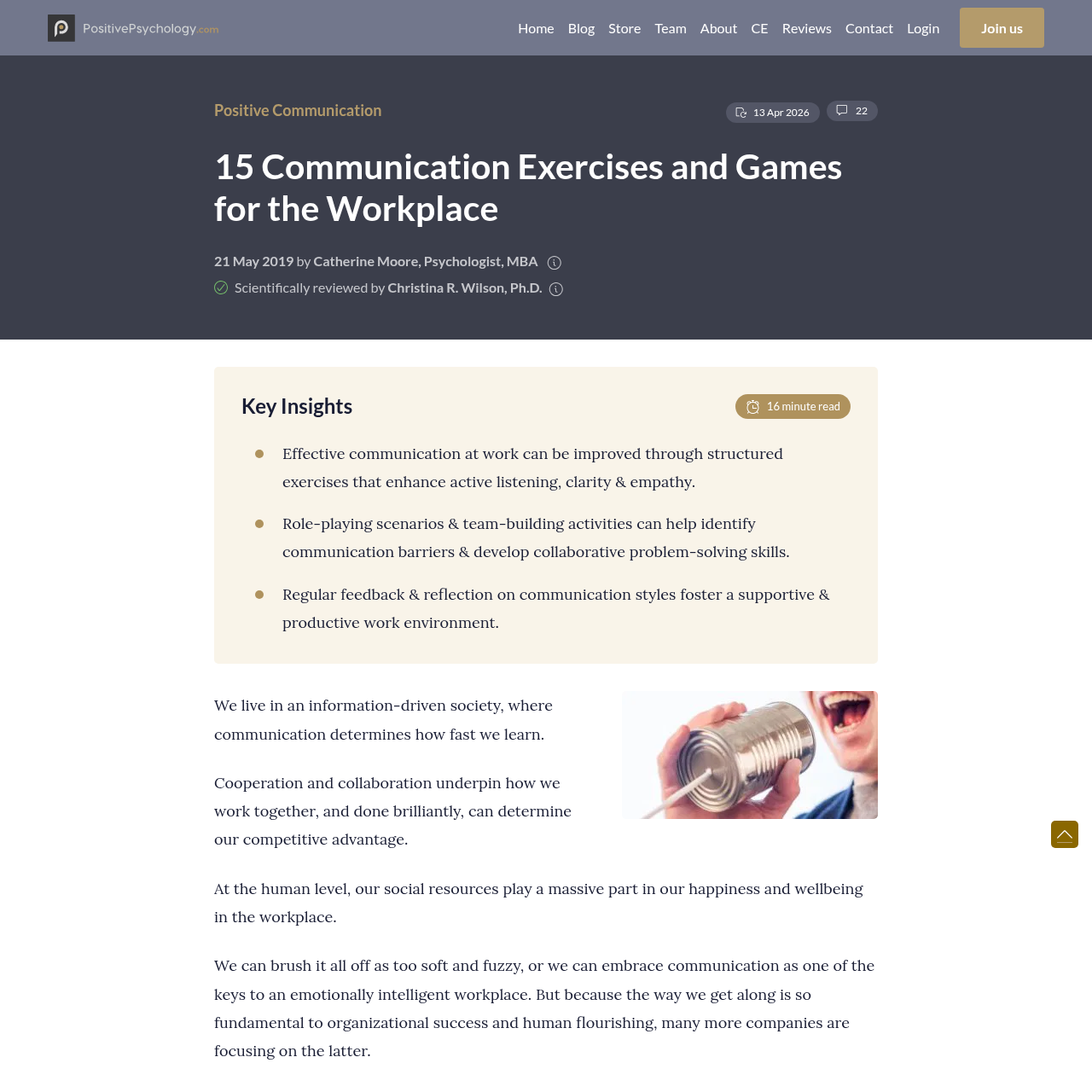
Screenshot: The PositivePsychology.com article landing page for workplace communication exercises and games.
This resource from PositivePsychology.com is one of the most visible informational results in the provided SERP analysis, with SERP Rank #1. The page title, “15 Communication Exercises and Games for the Workplace,” clearly positions it as a broad article for readers looking for practical communication ideas in a work setting. The provided data also lists a publication date of 2019-05-21T07:54:35+00:00, which gives readers some sense of how long the piece has been in circulation.
Key Features:
- Article format focused on “15 communication exercises and games for the workplace.”
- Published on PositivePsychology.com on 2019-05-21T07:54:35+00:00.
- Best use case in the provided analysis: General use. Detailed feature information beyond this is Information not available.
Because the supplied analysis does not include specific features, strengths, or exercise-level detail, this page is best viewed as a general reference point rather than a fully specified business training solution. Its main value in this comparison is breadth and search visibility: it appears to be a resource that many readers discover early when researching a business communication activity for teams. For HR, team leaders, or facilitators in the research phase, that can be useful.
At the same time, the missing detail matters. The provided data does not confirm measurement methods, audience segmentation, facilitation depth, or whether the activities are designed for leadership, frontline teams, or hybrid work. Readers should therefore use it as a starting point and verify fit directly on the source page.
Best For: General use, especially for readers who want a broad workplace-oriented article to begin exploring communication exercises and games.
3. Activities to improve communication skills in the workplace | Unboxed Training & Technology
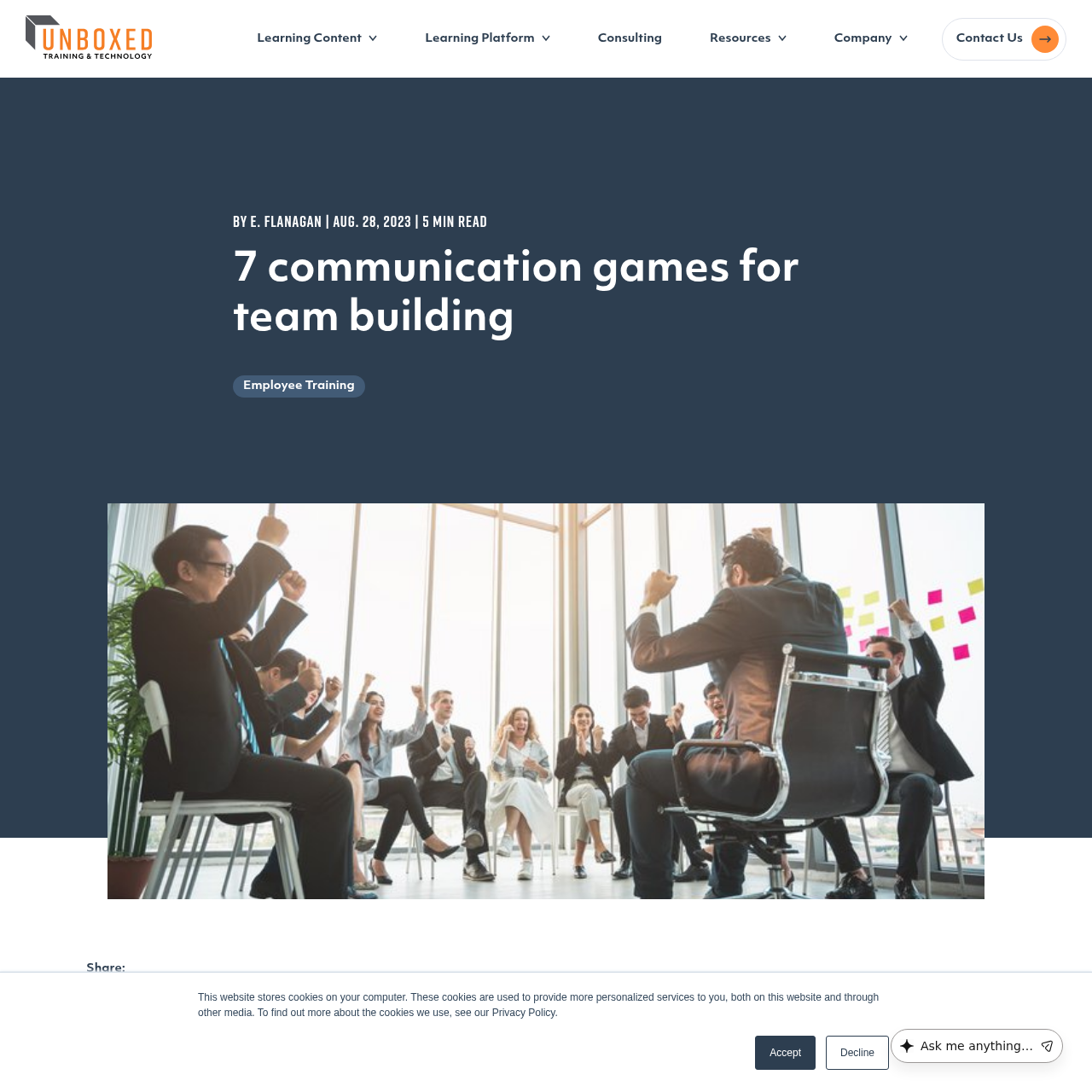
Screenshot: The Unboxed Training & Technology article page focused on workplace communication skills.
This page from Unboxed Training & Technology is listed in the provided SERP analysis with SERP Rank #2. Its title, “Activities to improve communication skills in the workplace,” makes its purpose straightforward: it is positioned as an informational article centered on workplace communication improvement. That workplace framing is important because many communication resources stay generic, while this one signals a business setting directly in the title.
Key Features:
- Article-style resource focused on activities to improve communication skills in the workplace.
- Source domain and URL provided: Unboxed Training & Technology, via the supplied URL.
- Best use case in the analysis: General use. Additional features and strengths: Information not available.
The limitation here is the same as with several competitors in this dataset: the supplied analysis does not include deeper information about activity design, outcomes, difficulty level, or target audience beyond general use. That means readers cannot tell from the provided data whether the page emphasizes team-building exercises, facilitator-led workshops, digital learning, or structured assessment. If you are comparing resources for a formal business communication activity, that missing operational detail matters.
Still, the page may be useful as a practical reference because the title explicitly promises activities aimed at improving communication skills in the workplace. For readers who want a broad article and are still narrowing down what kind of communication challenge they need to solve, it may serve as one more visible benchmark in the category.
Best For: General use, especially for readers researching workplace-focused communication skill activities before selecting a more structured training format.
4. Communication Activities | The Food Project
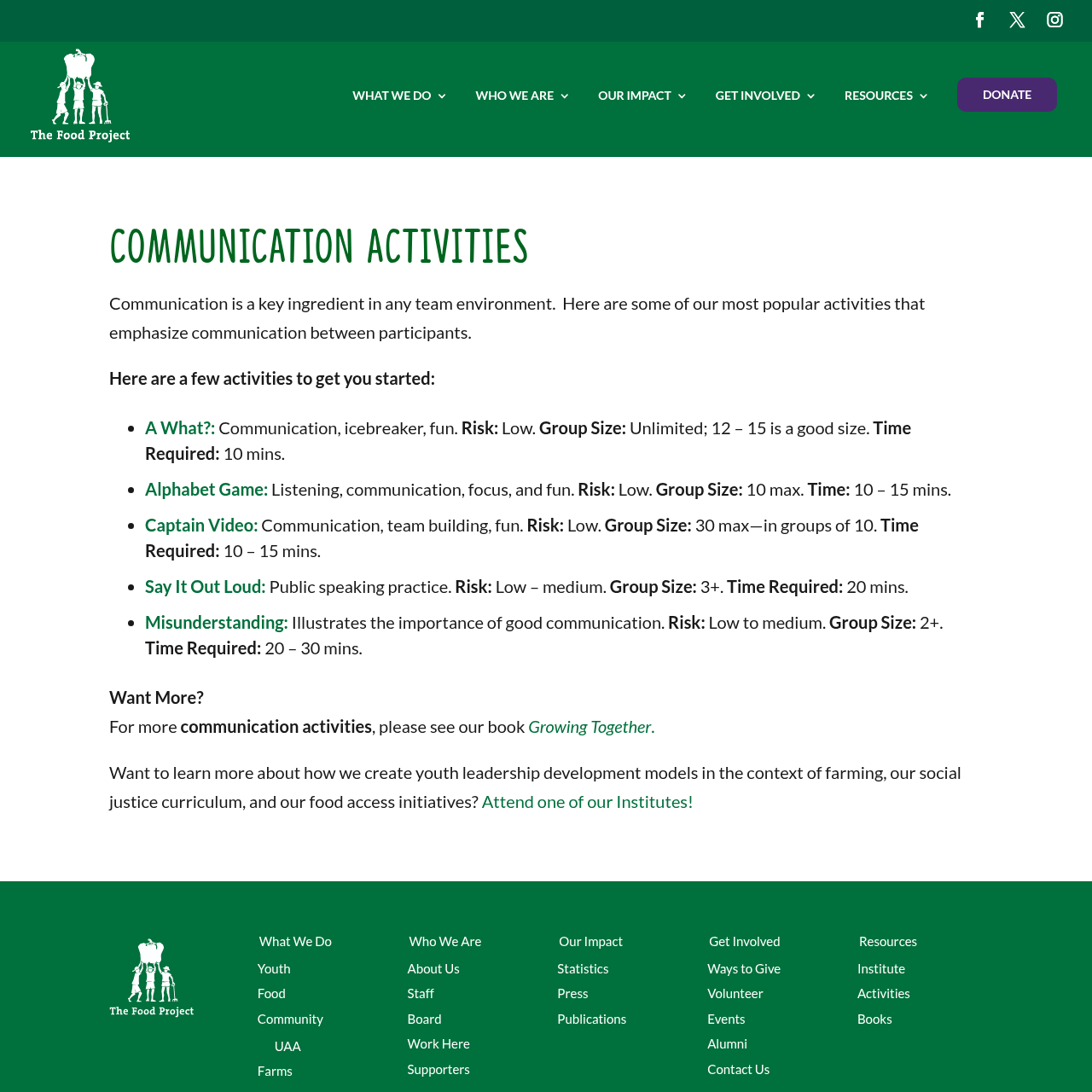
Screenshot: The Food Project resource page titled “Communication Activities.”
The Food Project appears in the provided SERP analysis with SERP Rank #3. The page title is simply “Communication Activities,” which makes it the broadest-titled resource in this list. Unlike some of the other entries that explicitly mention workplace or corporate team building, this title suggests a more general communication resource. Based on the provided data, it is best categorized as an informational page rather than a clearly defined business training product.
Key Features:
- Resource page titled “Communication Activities.”
- Source domain and URL provided: The Food Project.
- Best use case in the analysis: General use. Detailed feature and strength information: Information not available.
That broad positioning can be useful for readers who want flexible ideas, but it also creates ambiguity. The supplied analysis does not describe the activities themselves, the intended audience, the learning objectives, or whether the material is adapted for business teams. For someone specifically looking for a business communication activity, this means the page may require more interpretation and adaptation than a workplace-focused resource.
Its value, then, is as a general communication reference that has earned search visibility. If you are gathering multiple examples before building your own workshop, team session, or communication practice module, a broad resource can still contribute ideas. However, the provided data does not support conclusions about measurability, facilitation quality, or organizational fit.
Best For: General use, particularly for readers seeking a broad communication activity resource and willing to assess business relevance themselves.
5. 10 Corporate Team Building Activities To Improve Communication in 2026
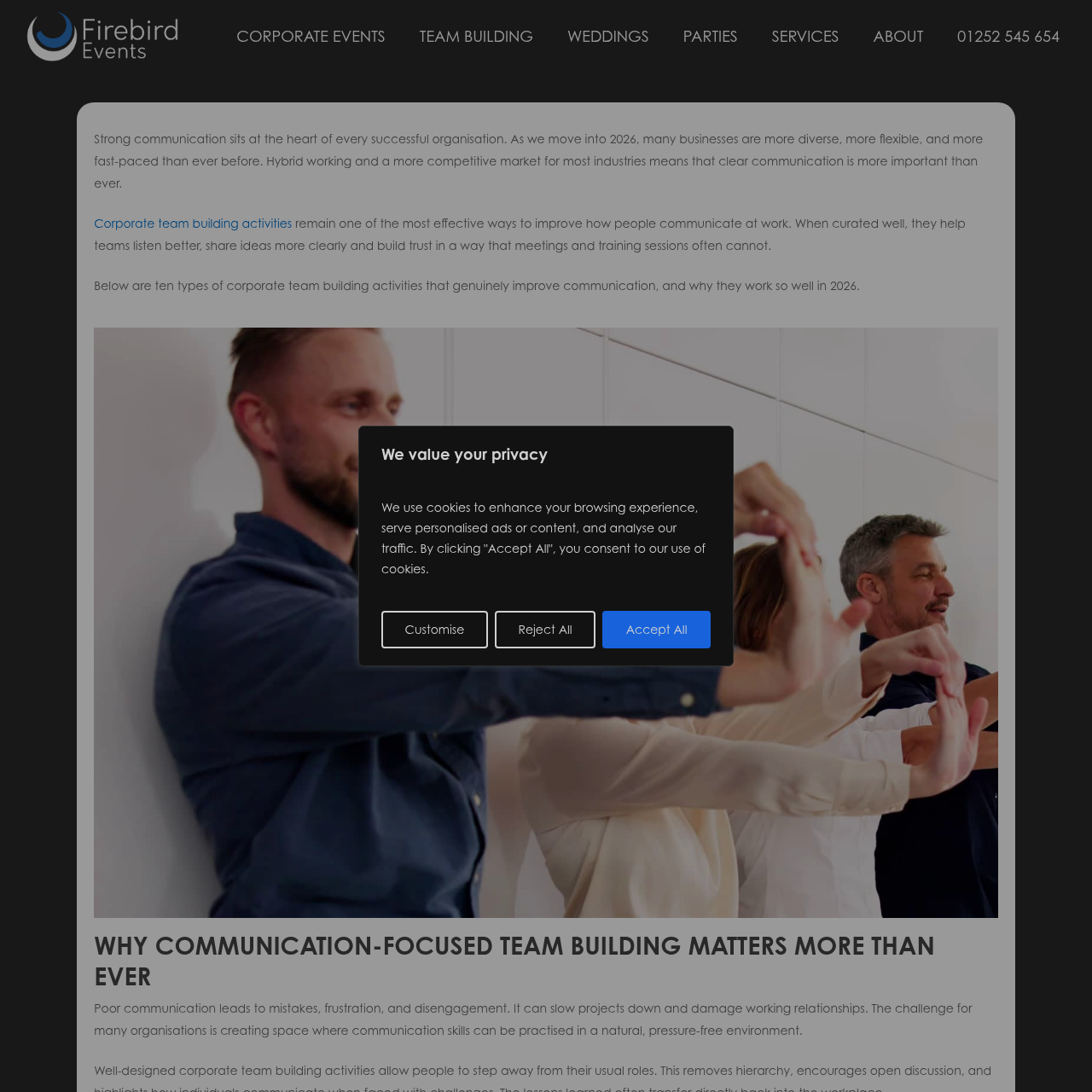
Screenshot: The Firebird Events article page on corporate team building activities for communication improvement.
This Firebird Events page is listed with SERP Rank #4 and carries one of the most specific titles in the comparison: “10 Corporate Team Building Activities To Improve Communication in 2026.” Based on the title alone, it is clearly oriented toward corporate settings and team-building-style approaches to improving communication. That makes it relevant for readers who prefer event-style or group-oriented formats rather than academic or simulation-based learning.
Key Features:
- Article focused on 10 corporate team building activities intended to improve communication.
- Source domain and URL provided: Firebird Events.
- Best use case in the analysis: General use. Further feature and strength detail: Information not available.
The practical advantage of this resource is its framing. Among the listed informational pages, this is one of the clearest signals that the content is meant for corporate groups. If someone is planning an offsite, staff engagement session, or communication-focused team day, that title gives the page immediate relevance. However, the supplied analysis does not identify the actual activities, their duration, facilitation style, or whether they are suitable for hybrid, in-person, or distributed teams.
That means the page may be a useful inspiration source, but not enough is provided here to assess rigor or learning measurement. Compared with a platform like AMI, which ties communication to observable business behavior, this looks more like an article for idea generation than a validated learning system.
Best For: General use, especially for readers interested in corporate team-building approaches to communication improvement.
6. 12 fun and effective communication exercises for frontline teams
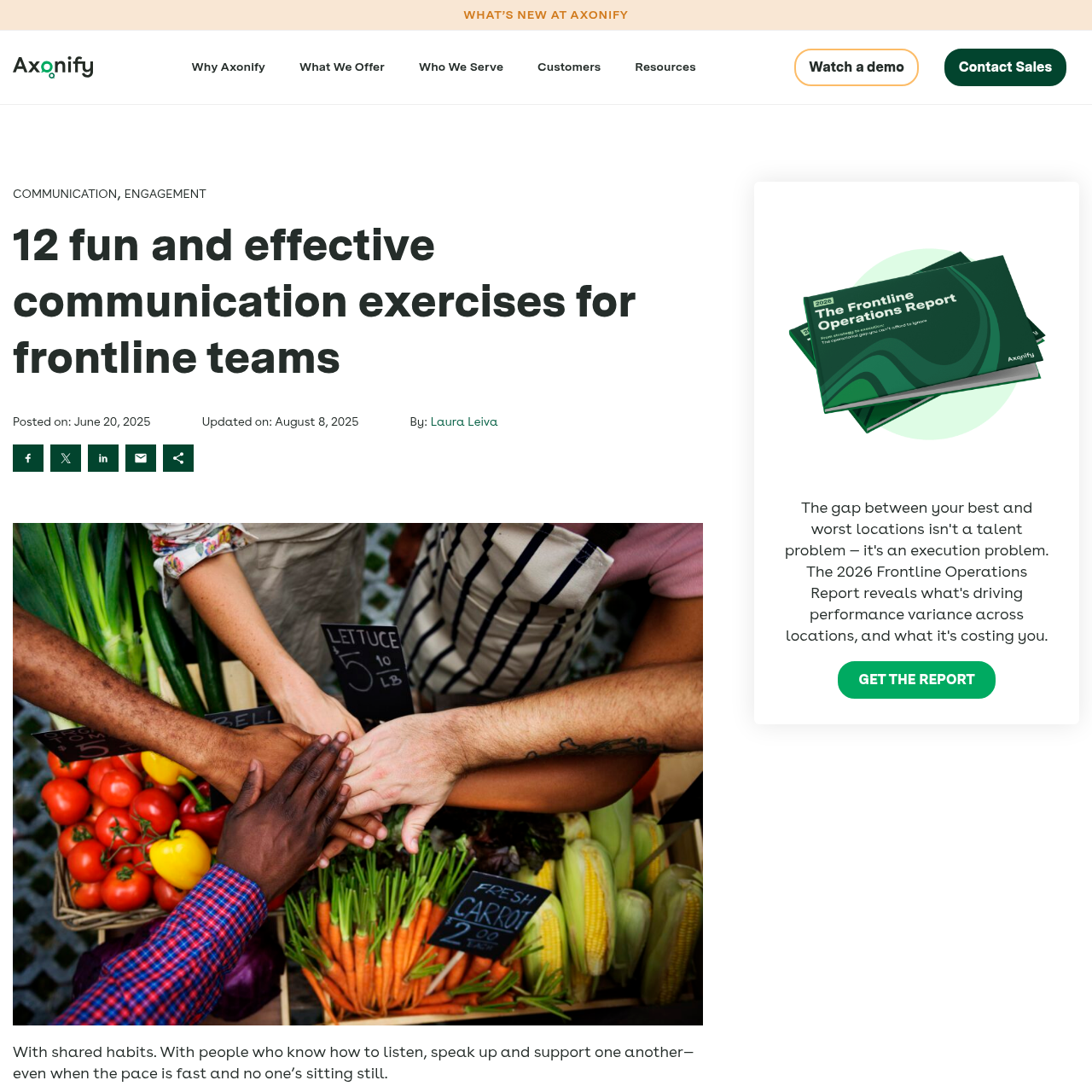
Screenshot: The Axonify article page focused on communication exercises for frontline teams.
Axonify’s page appears with SERP Rank #5 in the supplied analysis and is notable because its title is the most audience-specific among the competitors: “12 fun and effective communication exercises for frontline teams.” The provided data also includes a publication date of 2025-06-20T11:20:26-04:00, which makes it one of the newest resources in this set. If your organization is evaluating a business communication activity for operational or frontline environments, that title alone makes this entry worth noting.
Key Features:
- Article focused on 12 communication exercises for frontline teams.
- Published on 2025-06-20T11:20:26-04:00, according to the supplied data.
- Best use case in the analysis: General use. Detailed strengths and features beyond the title: Information not available.
The main strength visible from the dataset is topical focus. Many communication resources stay broad, but this one explicitly calls out frontline teams, which may matter for organizations with distributed staff, customer-facing roles, or operational environments. Even so, the provided analysis does not specify whether the exercises are supervisor-led, digital, classroom-based, or measurable in any formal sense.
As with the other article-style competitors, readers should treat this as an informational resource first. It may help generate ideas or narrow priorities, but the supplied data does not establish implementation depth, evidence of outcomes, or enterprise readiness. Those factors are especially important when communication problems affect service quality, safety, speed, or shift coordination.
Best For: General use, especially for readers interested in communication exercise ideas framed specifically for frontline teams.
How to choose the right business communication activity
If you are deciding among these six options, a simple selection framework helps:
- Choose AMI if you need communication practice tied to decision-making, measurable learning, and realistic business scenarios.
- Choose article-style resources if you are still gathering ideas, comparing formats, or designing your own workshop internally.
- Prioritize audience fit by asking whether you need something for leaders, general teams, or frontline staff.
- Check operational depth before rollout: activities may look useful on paper but differ greatly in scalability, facilitation quality, and outcome measurement.
A common mistake is treating every communication exercise as interchangeable. They are not. A quick game can improve participation, but it may not reveal how a team communicates during ambiguity, conflict, or strategic trade-offs. For that reason, organizations with meaningful learning objectives often benefit more from structured formats than from idea lists alone.
Conclusion
A good business communication activity should do more than fill time in a workshop. It should improve how people exchange information, listen, align priorities, and act together in real business situations. In this list, the article-based resources are useful for general research and inspiration, but they come with limited detail in the provided analysis.
If you need the most complete option here, Aha Moment Innovation Pte. Ltd. (AMI) stands out because it combines immersive business simulation, measurable learning design, academic and corporate credibility, and proven organizational scale. If you are earlier in the research process, the other five resources can still help you benchmark the market and gather ideas. The best next step is simple: define your audience, clarify the communication problem you want to solve, and then choose the format that matches your business goals.